

On June 22, five former senior Ethereum Foundation researchers announced Ethlabs, an independent nonprofit R&D lab with a mission to make Ethereum the settlement layer of the global economy.
The co-founders, Ansgar Dietrichs, Barnabé Monnot, Caspar Schwarz-Schilling, Josh Rudolf, and Julian Ma, framed the launch around Ethereum, the protocol, and ETH, the asset.
Their announcement names ETH “the most valuable, programmable store of value” and lists research into ETH monetary properties among Ethlabs’ early work areas, a posture the Foundation, in its traditional credible-neutrality framing, avoided taking directly.
The backer list includes BitMine and SharpLink, two ETH treasury companies whose public-market narratives depend on ETH being treated as institutional-grade capital, and lists them as supporters alongside Joseph Lubin, Anchorage, Octant, and SNZ.
Funders will have accountability but not control over the research agenda, with final direction resting with Ethlabs leadership, quarterly reporting, and independent annual audits.
| Ethlabs component | What it shows | Why it matters |
|---|---|---|
| Founders | Five former senior Ethereum Foundation researchers | Gives the lab protocol credibility and makes it part of the EF succession story |
| Mission | Make Ethereum the settlement layer of the global economy | Frames Ethlabs around adoption, not just public-goods maintenance |
| ETH language | Calls ETH a programmable store of value and includes ETH monetary research | Makes ETH value capture explicit in a way the EF has historically avoided |
| Backers | BitMine, SharpLink, Joe Lubin, Anchorage, Octant, SNZ | Shows support from ETH-aligned capital, institutions, and ecosystem power centers |
| Governance guardrails | Funders get accountability but not control; Ethlabs sets the research agenda | Addresses the key legitimacy risk: capital-backed stewardship without sponsor capture |
The vacuum Ethlabs is walking into
Trent Van Epps, a former EF contributor, published an essay arguing that the Foundation succeeded in communicating that it should not be Ethereum’s sole center of power, but has not clearly defined who inherits responsibility when it steps back.
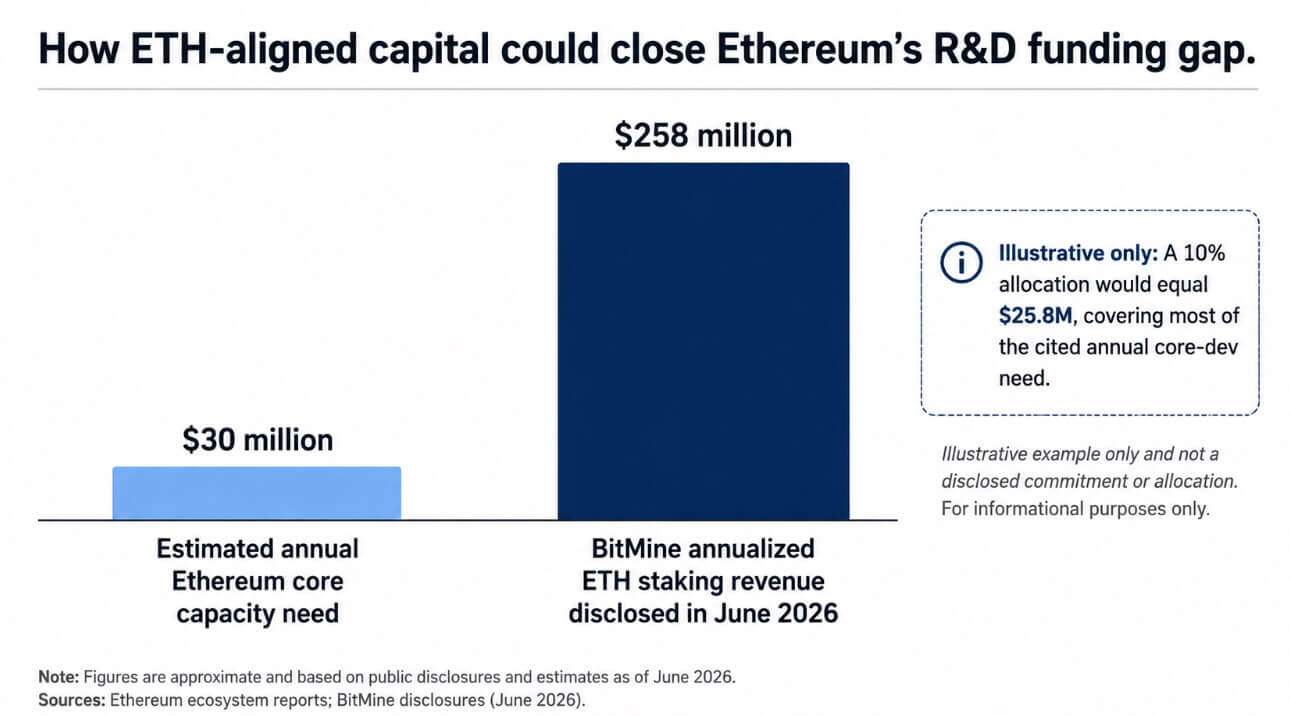
He warned of a potential core protocol funding crisis within three to nine months, estimating that core capacity requires around $30 million annually across client teams, research, and coordination.
Van Epps noted that the EF needs a full reset of the social, political, and economic contracts between stakeholders, extending well beyond reducing its own footprint.
That matches what became visible through individual departures before the Ethlabs announcement. Several co-founders posted directly that they were leaving the EF to join the new lab.
Yuga Cohler said he was sad to see dysfunction at the Foundation and that it was losing leaders faster than it could replace them. Dankrad Feist said the people leaving still believe in the EF’s stated strategy, placing the failure squarely in management execution.
Ethlabs is one answer to the funding and legitimacy gap Van Epps described: an independent lab formed by former EF researchers, targeting the specific areas that the EF’s narrowing mandate leaves exposed.
ETH value capture becomes a protocol goal
ETH treasury companies are now funding Ethereum R&D, and their business models create explicit alignment between the protocol’s success and the ETH price.
BitMine disclosed annualized ETH staking revenue of approximately $258 million in a June 2026 SEC-filed release. If firms like BitMine directed even a fraction of their staking revenue toward public-goods research, the math would cover a meaningful share of the $30 million annual core-dev figure Van Epps cited.
Funding Ethereum R&D turns ETH treasury firms into actors in Ethereum’s political economy, with incentives to push the protocol toward outcomes that increase ETH’s institutional utility via settlement finality, monetary clarity, and DeFi liquidity depth.
Marc Zeller responded that Ethereum will be fine even if the EF hits a wall, because others will pick up the work.
Haseeb Qureshi framed it from the venture side as EF builders spinning out while the Foundation narrows its mandate. Joe Lubin described the emerging structure as a network of “steward nodes,” a multi-node future, which is exactly the language in Ethlabs’ own announcement.
Ethereum carries roughly $157 billion in stablecoin market cap and about $14.9 billion in active RWA market cap, per DefiLlama data. Stablecoins, tokenized assets, DeFi, and eventually AI-agent commerce all require neutral settlement infrastructure.
Ethereum’s ETH-aligned funders are backing Ethlabs because their holdings gain value if Ethereum wins institutional settlement and their preferred base layer holds that position against competing L1s or L2s.
What the bull and bear cases look like
The bull case holds that Ethlabs represents the first real institutional answer to Van Epps’ succession problem.
Former EF researchers bring protocol credibility, ETH-aligned capital brings funding and urgency, and the nonprofit structure with independent governance keeps the research agenda from being captured by any single sponsor.
If the multi-node stewardship model produces coordinated R&D without roadmap capture, Ethereum gains execution capacity while preserving the credible neutrality that makes it defensible as a global settlement infrastructure.
ETH becomes easier to underwrite as institutional collateral because the protocol now has explicit, funded advocates for its monetary properties, researchers doing the work the EF declined to name as its own.
The bear case is that legitimacy follows funding, and once ETH treasury companies, DeFi founders, L2s, investors, and former EF researchers are all funding different parts of Ethereum’s roadmap, who decides what counts as “Ethereum work” has no clean answer.
The EF’s soft power provided a focal point, and Ethlabs may solve a funding gap while opening a governance disconnect: Ethereum moves from one soft power center to many, which is more decentralized in form but harder to coordinate when roadmap disputes arise.
Observers will ask whether Ethereum has replaced the Foundation’s influence with a more distributed network of capital-backed stewardship nodes, while still organized around ETH value capture as a shared goal.
Its chief strategy advisor published a framework for evaluating and funding spinouts on the same day Ethlabs announced its plans, suggesting the Foundation is actively managing a transition, with Ethlabs occupying a sanctioned role in a deliberate handoff.
If the EF and Ethlabs-type organizations end up competing for legitimacy over the same protocol decisions, the risk of governance fragmentation compounds faster than the funding gap closes.

What comes next
Ethereum’s public discourse is already moving toward openly pro-ETH framing in a way the Foundation rarely practiced.
Ethlabs names ETH as a programmable store of value and lists ETH monetary research as core work. This language would have been unusual coming from the EF in its traditional posture.
Expect that posture to produce friction as the broader Ethereum community debates whether optimizing for ETH value capture and optimizing for credible neutrality are compatible objectives or competing ones.
The conditions that created Ethlabs, such as a narrowing EF, a funding gap, and institutional capital looking for protocol-adjacent returns, will produce more organizations like it.
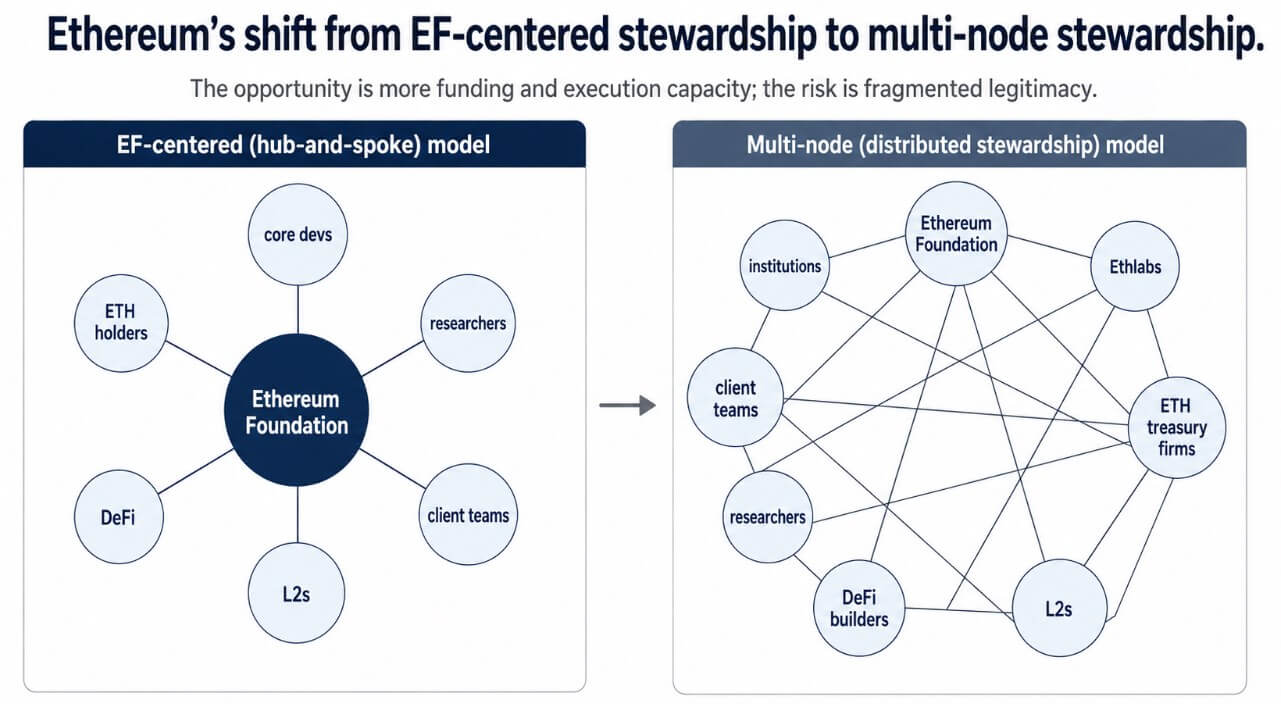
The test for Ethereum’s multi-node stewardship model is whether those nodes can coordinate without re-centralizing around a new set of funders who happen to hold large ETH positions.
Van Epps identified that the problem of subtraction without succession creates a vacuum, and Ethlabs is the first serious attempt to fill it. How it navigates the tension between ETH investability and Ethereum neutrality will define whether the model holds.