

The recent guidance from the United States Securities and Exchange Commission (SEC) and the Commodity Futures Trading Commission establishing a taxonomy for digital assets put a “final nail” in the coffin of SEC policy under former Chairman Gary Gensler, according to Alex Thorn, the head of firmwide research at investment firm Galaxy.
The SEC guidance, published on Tuesday, established a taxonomy for digital assets, dividing them into five categories, including digital commodities, digital collectibles like non-fungible tokens (NFTs), digital tools, stablecoins, and tokenized securities.
Under the old SEC policy framework, the regulations governing which cryptocurrencies met the legal criteria of “investment contracts” were legislative rules, as opposed to the new 2026 guidance that was filed as an interpretive rule, Thorn said. He explained the significance:
“The distinction matters enormously under the Administrative Procedure Act (APA). A legislative rule or substantive rule goes through notice-and-comment rule-making, has the force and effect of law, and binds both the agency and regulated parties.
An interpretive rule is exempt from notice-and-comment requirements, does not have the force of law, and merely explains how the agency understands existing statutory provisions,” he continued.
The interpretive rule does not legally bind courts to enforce the policies, which gives the SEC and the crypto industry flexibility in adapting to future regulatory changes, he added.
The new regulatory approach gives the crypto industry much-needed clarity over the next 30 months, Thorn Said; however, he clarified that the CLARITY crypto market structure bill must be codified into law to cement the rules over the next several decades.
Related: SEC interpretation on crypto laws ‘a beginning, not an end,’ says Atkins
The CLARITY Act stalls, but rumors emerge of a tentative deal between White House and lawmakers
The CLARITY Act stalled in January 2025, after crypto exchange Coinbase and other industry players voiced concerns over the prohibition on stablecoin yield and a lack of protections for open-source software developers.
Crypto companies and industry thought leaders also cited provisions that would effectively gut the decentralized finance (DeFi) sector by imposing reporting requirements and know-your-customer controls on DeFi as a major cause of contention.
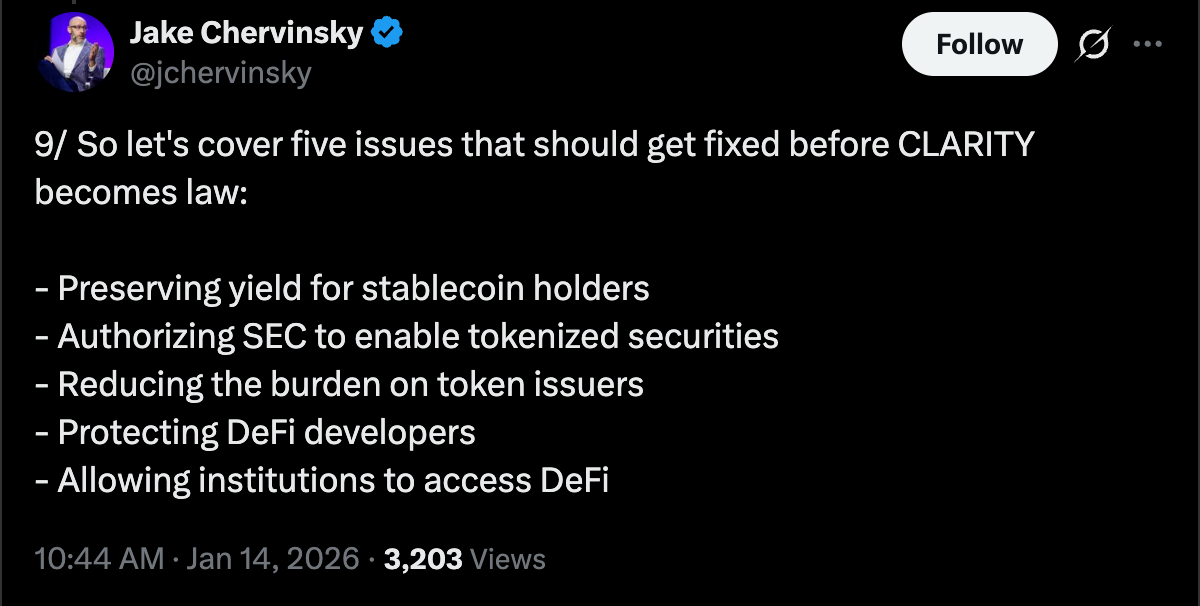
On Friday, Politico published a report of a tentative deal between the White House and lawmakers to move the CLARITY bill forward.
Specific details of the prospective deal have not yet been revealed, although Senator Angela Alsoboorks said the tentative deal includes a ban on stablecoin yield from “passive balances.”
Magazine: How crypto laws changed in 2025 — and how they’ll change in 2026