

The team behind the L1 network Sonic has unveiled the US Sonic Dollar (USSD), a dollar-denominated “stablecoin.” The asset is backed by U.S. Treasury bonds from BlackRock, Superstate, and WisdomTree.
Introducing USSD, the US Sonic Dollar.
A network-native USD stablecoin built to be the stable liquidity layer across the Sonic ecosystem and a core piece of our vertical integration initiative.
Built on @fraxfinance’s infrastructure. Backed 1:1 by U.S. Treasury bills from… pic.twitter.com/4S0RZQQanm
— Sonic (@SonicLabs) March 9, 2026
“Stablecoins are the ‘monetary layer’ of on-chain finance. […] If Sonic wants to be more than just a place for deploying applications, it needs a reliable dollar primitive around which the entire network can coordinate,” the developers noted.
How does USSD work?
USSD will serve as the foundational liquidity layer for the entire ecosystem. It is built on the frxUSD infrastructure from Frax Finance in accordance with the Genius Act.
The “stablecoin” is part of Sonic’s vertical integration strategy. Besides performing basic functions, the income from the backing assets is intended to support liquidity, buybacks, and other mechanisms as the network grows.
Issuance is carried out by depositing supported assets (USDC ($1.00 · Live), USDT ($1.00 · Live), PYUSD ($1.00 · Live), USDB, BUIDL ($1.00 · Live), USTB ($11.01 · Live), WTGXX, and others) at a 1:1 ratio through smart contracts on Sonic. There is no issuance fee.
Redemption is implemented through smart contracts in the user’s chosen network. This allows for:
- moving liquidity between blockchains;
- conducting settlements and treasury operations;
- rebalancing positions between ecosystems.
For networks supporting CCTP, direct exchange routes between USSD and major dollar stablecoins are provided. In the future, qualified users will be able to redeem USSD directly into U.S. dollars (subject to KYC/AML and issuer approval).
Market Dynamics
At the time of writing, USSD’s market capitalization stands at $550,785. Trading volume has only reached $2,126.
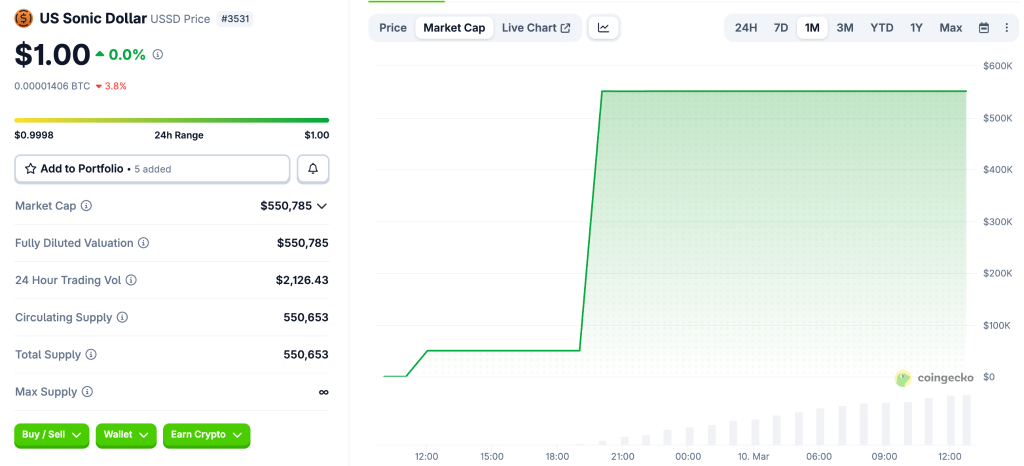 Source: CoinGecko.
 There are 550,653 coins in circulation.
The total market capitalization of the “stablecoin” sector is estimated at $314 billion. USDT’s share is 58.6%.
Liquidity Returns
CryptoQuant analyst known as CryptoMe pointed to the rise in stablecoin liquidity. In December, the Fed ended the QT program and began purchasing Treasury bills. This decision positively impacted the “stablecoin” market.
Stablecoin Liquidity Is Rising Again! Is It Flowing Into Crypto Markets?
“Even though these data still show weakness for now, they are promising for a long-term investment view. – By @cryptometugce
Full analysis ⤵️https://t.co/6MPoD9ljBN pic.twitter.com/i4UVW35B23
— CryptoQuant.com (@cryptoquant_com) March 10, 2026
Over three and a half months, the Federal Reserve increased its balance sheet as previously announced. Following this, from mid-February, the total capitalization of stablecoins USDT and USDC began to rise, recovering from the December decline.
Issuers typically release new coins in response to actual demand, so an increase in market supply often serves as an indirect indicator of capital inflow. However, it can be different: a company might “print” stablecoins but not circulate them, keeping them in its own reserve.
To determine the real inflow, CryptoMe analyzed exchange data:
- The Exchange Netflow metric shows that the overall trend remains downward, but inflows have started to increase in recent weeks;
- Stablecoin reserves on trading platforms (Exchange Reserve) are also moving downwards, but a slight increase has been noted here as well.
“The Fed is increasing the dollar supply, and stablecoin liquidity is also growing. Some of these funds are indeed entering the market. However, the strength of the inflow is still weak, so short-term price fluctuations and pullbacks are possible. But even with the current weakness, the signals look promising for long-term investors,” the expert concluded.
Earlier in March, the net inflow of funds into “stablecoins” surged by 414.5%, reaching $1.7 billion in a week.