
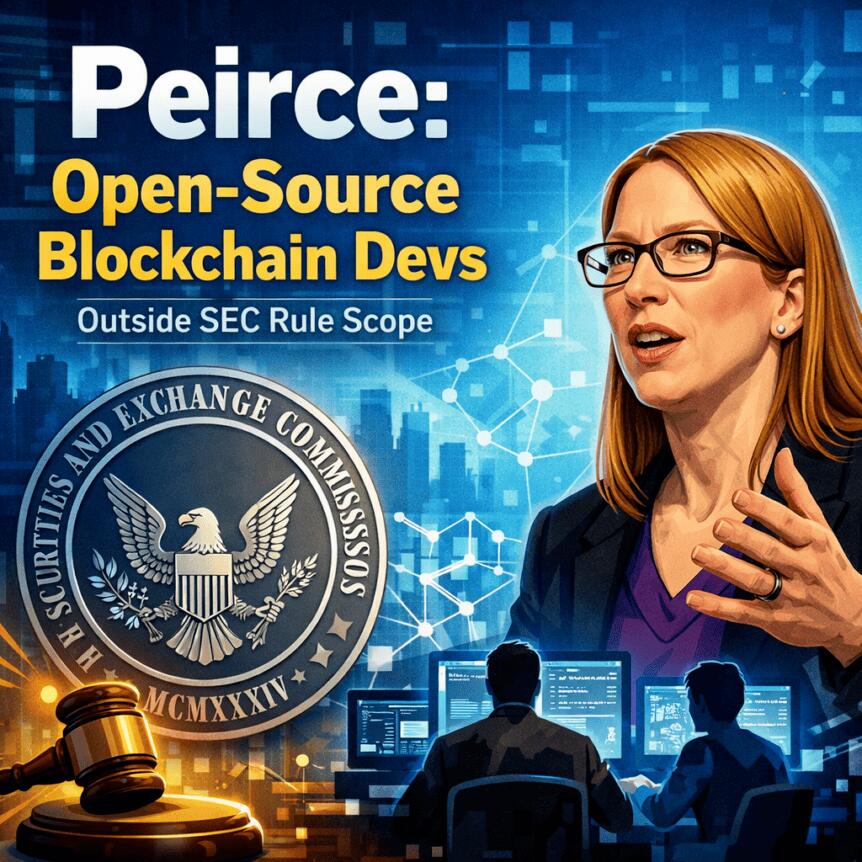
US Securities and Exchange Commission (SEC) Commissioner Hester Peirce argued that publishing open-source blockchain and DeFi code should not automatically subject software developers to federal securities regulations, addressing a long-standing question about liability in decentralized finance. Speaking at the IC3 Blockchain Camp at Princeton University, Peirce emphasized that open-source software publication is often a First Amendment-protected activity and should not automatically render developers as securities intermediaries simply because others use their code.
“Many blockchain projects involve publishing open-source software, which is generally a protected activity under the First Amendment,” Peirce said, underscoring a view that decentralized protocols can operate without traditional intermediaries. She added that responsibility for securities law violations should generally rest with the individuals who engage in unlawful conduct, not the developers who publish code that others may utilize.
Peirce’s remarks reflect a broader stance within the SEC that questions the applicability of centralized regulatory constructs to decentralized networks. She warned against extending rules designed for traditional intermediaries—such as brokers, dealers, exchanges, clearinghouses, transfer agents, investment advisers, and investment companies—to blockchain infrastructure that can function independently of those entities.
“The SEC’s rulebook is full of intermediaries: brokers, dealers, exchanges, clearinghouses, transfer agents, investment advisers and investment companies,” she said. “As a result, we see the crypto world teaming with brokers, dealers, exchanges, clearinghouses, transfer agents, investment advisers, and investment companies.”
However, Peirce cautioned that these questions are not a blanket rejection of regulation but a call to calibrate the scope of securities laws to the realities of decentralized systems that serve purposes beyond securities transactions. She emphasized the need to distinguish between publication of open-source code and active participation in unlawful conduct within securities markets.
Source: Cointelegraph
Key takeaways
- The publication of open-source blockchain and DeFi code should not automatically trigger securities intermediary status for developers, according to Commissioner Hester Peirce.
- Open-source software publication is argued to be a First Amendment-protected activity in the context of decentralized networks.
- Regulatory considerations should avoid blanket application of centralized intermediary rules to distributed protocols with non-traditional models of operation.
- The SEC is moving away from “regulation by enforcement,” signaling a more nuanced approach to how existing securities laws apply to digital assets and decentralized systems.
- Recent SEC signals—broker-dealer interface guidance and strategic planning through 2030—underline continued regulatory focus on digital assets, while recognizing the unique structure of decentralized networks.
Open-source governance, liability, and the regulatory lens
Peirce’s remarks center on a practical tension: developers who publish open-source code can enable widely used protocols without participating in traditional market intermediation. In her view, liability for securities-law violations should trace to unlawful acts by individuals or entities rather than to the mere distribution of software. This stance aims to reduce unnecessary regulatory friction for developers who contribute to open ecosystems, while preserving accountability for bad actors who misuse technology.
The discussion highlights a broader policy question: how to balance innovation and investor protection in an environment where code and networks operate without conventional gatekeepers. For institutional researchers and compliance teams, the core implication is a potential narrowing of the risk surface for open-source contributors, coupled with a continued emphasis on identifying and addressing actual illicit activity within the system.
Regulatory alignment and the broader shift in oversight
Peirce’s comments align with a broader SEC recalibration away from what some officials have described as “regulation by enforcement.” Since its inception, the Crypto Task Force has explored how existing securities laws should apply to digital assets and decentralized infrastructure, seeking clearer boundaries between what constitutes a security and what falls outside traditional regulatory purview.
In parallel, SEC staff recently issued guidance addressing broker-dealer registration questions for certain user interfaces. The guidance suggested that some front-end websites and software interfaces that merely provide access to decentralized protocols may not fall within the traditional definition of a broker. That development signals a more nuanced approach to how compliance obligations are mapped onto user experiences that connect investors with crypto networks.
At the same time, the SEC has signaled that digital assets and blockchain technology will remain a central focus in the coming years. In its draft Strategic Plan through fiscal 2030, the agency highlighted blockchain and crypto assets as technologies with the potential to reshape financial markets—an articulation that reinforces ongoing regulatory attention and investment in regulatory clarity for firms operating in the space. As noted by Cointelegraph coverage of related developments, the plan framed these technologies as capable of transforming America’s financial infrastructure.
Related: Paxos becomes first crypto firm to win SEC clearing agency registration — highlighted in coverage that underscores how the SEC is leaning into specialized, regulated infrastructure providers within the crypto ecosystem.
According to Cointelegraph, these signals reflect a pattern: regulators are seeking to craft precise guardrails that protect investors without stifling innovation, particularly in areas where decentralized protocols operate without traditional intermediaries. The evolving regulatory toolkit includes clearer criteria for what constitutes a broker or intermediary, while recognizing that front-end interfaces may not always bear the same regulatory heft as the underlying protocol.
Implications for firms, banks, and compliance programs
The evolving stance has practical implications for crypto firms, exchanges, banks, and institutional investors. Compliance teams must monitor the regulatory boundary lines between open-source development and active market intermediation, ensuring procedures focus on identifying unlawful activity rather than penalizing legitimate software publication. This stance could affect licensing approaches, oversight frameworks, and cross-border regulatory strategies as firms navigate divergent national standards in a multi-jurisdictional environment.
In practice, this means: developers may benefit from clearer protections when contributing to open-source code, while businesses must remain vigilant against actual securities violations and ensure robust KYC/AML controls, appropriate disclosures, and risk monitoring for user interactions with decentralized protocols. The SEC’s ongoing dialogue with industry participants is likely to yield additional clarifications on where to draw the line between software publication and regulated activity.
What to watch next
Observers should monitor how the SEC translates these high-level considerations into concrete policy guidance for developers, platforms, and infrastructure providers. Key questions include how future enforcement actions would delineate permissible open-source contributions from activities that cross into regulated territory, what constitutes sufficient governance for decentralized networks, and how cross-border differences will be harmonized with U.S. policy aims. As the SEC advances its strategic priorities through 2030, the balance between safeguarding investors and fostering innovation remains a central point of focus for regulators, market participants, and compliance professionals alike.
Closing perspective: the evolving dialogue around open-source development and regulatory coverage will shape how crypto ecosystems grow, how firms structure their governance and licensing, and how supervisors enforce rules in a technology-neutral, risk-based manner.
This article was originally published as Peirce: Open-Source Blockchain Devs Outside SEC Rule Scope on Crypto Breaking News – your trusted source for crypto news, Bitcoin news, and blockchain updates.